The Modern Era Is Characterized by Improvised or Do-it-yourself Forms of Family.
The new era of type
We're a few decades into the era of digital typography – long enough to take for granted that we have access to computers, printers and a vast range of typefaces. The desktop publishing revolution gave everyday users and professionals alike access to tools for typesetting, but it'south taken some time for things to settle into a full general understanding of the possibilities of these tools.
Many have proved useful for web design, too, although ironically the text experience has been one of the near constrained aspects of web development. Thanks to a reliance on users' installed fonts, the searchable, scalable, accessible content of the cyberspace has been deprived of the potential richness of a full typographic palette, which we've grown to expect in print.
The dynamic delivery of fonts required by a web page might not seem like much on the surface of things, merely just think almost how much we communicate with typography. We can analyze complex information with type; we can convey emotion and tone; we tin add together an implicit message to the words we commutation. In a world of many different devices for many different users, typography remains the most adaptable way to enrich a message or improve an experience.
In the early days of desktop publishing, type designers and users had to adjust to the limitations of the coarse resolution of the printers available at the fourth dimension. Similarly, the current spread of web fonts finds designers and users grappling with the resolutions of a variety of displays, most of which are still very low compared to the printed page.
If designers and users desire to gauge the quality of their typefaces in digital media, they need to look closely at what happens to screen pixels rather than printed dots. Do the letters in a given font align with one another? Do their outlines announced jagged, or practice they reach the illusion of smooth angles and curves? Do some of the letters look too dark or too low-cal? Do they collide when they shouldn't? In the same way that nosotros look hardware and software to improve, typographers need to look closely at the style that their blazon appears in utilize. The contempo explosion of type designed for the screen introduces merely a few unlike variables compared to the handful of reliable choices we have had and then far.
Web font services stand for the real shift in the style we tin work with type today. Since fonts are delivered from a central server on the wing, the virtually current version of the font data will e'er be the version seen by the user. This ways that foundries and type designers tin can continually improve their fonts, propagating updates in a way that is impractical with offline fonts. Every bit Os rendering and browser support evolves, users can enjoy the benefits of fonts with better and ameliorate hinting, language support and typographic features.
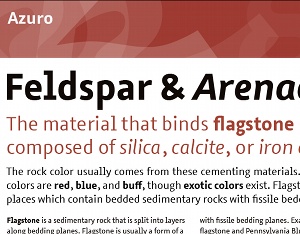
Equally nosotros get used to the spread of a digital environment, designers and foundries are responding with more than refined data for existing designs. Nosotros're also seeing designs adjusted for screen displays – such equally Webtype's Reading Edge series – or fifty-fifty typefaces that anticipate screen-use right from the start, like Microsoft's ClearType collection or Georg Seifert's Azuro. In projects like these – and more are certainly on the way – the shapes of individual letters, the spaces in and around them, and the overall feel are all designed to be as clear every bit possible on a variety of screens, giving designers and readers alike the best-quality building blocks for their digital projects.
This might all audio as though the state of typography for the screen is in the hands of type and software vendors, but this isn't entirely the case. They might provide the raw materials, but the existent potential of screen typography lies in the hands of the people who use the type. Typography is, later on all, the art of using typefaces. Now that the tools are improving, the industry is waiting to see what designers and other users practise with them. How will they – how will you – show the world what digital typography is capable of doing?
Related articles
Source: https://www.creativebloq.com/computer-arts/new-era-type-10118500
0 Response to "The Modern Era Is Characterized by Improvised or Do-it-yourself Forms of Family."
ارسال یک نظر